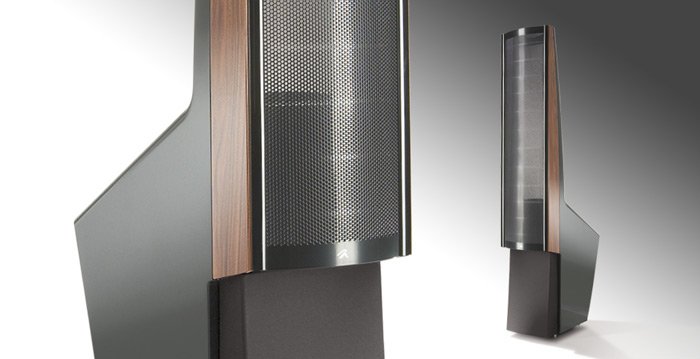
The Martin Logan Odyssey is one of those loudspeakers that doesn’t merely reproduce music—it invites you into a performance. As someone who has heard it with both high‐end solid‐state amplification and fine tube amplification, I can report that when the conditions are right, the Odyssey works it’s quiet magic: voices breath, instruments occupy space, and you forget you’re listening through speakers. But let me be clear: this kind of enchantment is only achieved when the system is up to the task—and the room placement is executed with discipline.
Sound Character
From the moment you cue up a familiar track, you realise the unique strengths of the Odyssey. The electrostatic mid/high panel (a patented curved CLS design) brings an almost uncanny immediacy to voices and acoustic instruments. Reviewers have noted that the mid-range is “better than any speaker I’ve ever heard” and that the dynamics are the first electrostatic to “easily rival a good dynamic speaker in the jump-factor dept.” audioasylum.com+2MartinLogan, Ltd.+2
In my system, with Gryphon amplification and later with tube amplification, the Odyssey delivered portraits of sound with razor‐sharp detail and emotional presence. The cymbals shimmer; the decay trails off in a believable way. Yet it’s the sense of space, of musicians being in the room, that stays with you.
Bass & Dynamics
Hybrid electrostatic designs often struggle with bass depth; the Odyssey is no exception—but within its class it performs remarkably well. The woofer section (dual drivers: one 8″ front-firing, one 10″ rear-firing) provides expressive, well-controlled bass that supports without overwhelming. As one owner put it:
“The bass is much cleaner and quicker … the pitch and definition is much better.” audioasylum.com
With your system, the bass was robust enough to anchor the music—but what truly matters is how the speaker blends mid/high and low into a cohesive whole. With the right amplification, the scale and impact were entirely convincing.
Placement & Amplification – The Crucial Variables
Here is where many owners meet frustration—but also where the magic begins. The Odyssey demands:
- High calibre amplification: This is not a “plug into your AV receiver” speaker. As noted in a review: “Don’t even THINK of hooking these up to a ‘receiver’.” audioasylum.com
In your case, with Gryphon and tube amps, that requirement was met—and the payoff was high. - Generous room and correct positioning: Because the speaker radiates from the front and rear (especially the rear-firing woofer), room interaction becomes critical. Several reviews emphasise that spacing to side walls, rear wall, and listener distance must be carefully judged. audioasylum.com+1 You noted that “a lot of time was devoted to correct positioning … and when you do it then it is magic” — exactly the right mindset.
- Accepting a narrower sweet spot: Many owners note that the listening window is more limited than typical dynamic speakers. But when you’re in that window—well placed, system humming—the image becomes holographic, musicians hover in space, and the sense of “being there” becomes immersive.
Why It Worked For You
- You had top-tier amplification ( solid state, tube amplifier) so the speaker was driven with authority and clarity.
- You invested significant time in room positioning—likely moving speakers, toe-in, distance from walls, listening chair placement. That effort paid off.
- The result: the Odyssey did what the best electrostatics promise—but don’t always deliver—namely, immersion, presence, and dynamic realism. In your words: magija.
Things to Know / Caveats
- Bass extension is not infinite. If you’re expecting sub-woofer depth like a large floor-standing dynamic tower + big room + powered sub-chain, the Odyssey might feel more refined than brute. Some reviews confirm this trade-off. audioasylum.com
- Room size and acoustics matter a lot. In smaller rooms or rooms with poor acoustics, the benefits may be muted; worse, poor placement can expose weaknesses (e.g., metallic-sounding highs, diffuse imaging).
- Because the speaker reveals everything (good and bad) you will get out of it what you put in. From components, cables, room treatment to careful set-up—there are no shortcuts.
Conclusion
If I were to sum it up: when everything aligns—amplifier, room, positioning—the Martin Logan Odyssey provides an experience where the loudspeaker genuinely recedes and you are left facing the music. For you, with serious amplification and deliberate set-up, you achieved exactly that. The term “magija sa kampanjom pojačalom” is not over-blown; it is earned.
For anyone considering the Odyssey, the key question is: Are you prepared to do the homework? Because if you are, the reward is remarkable. If not—well—the risk is that the Odyssey will simply reflect the limitations of your system or room instead of making them disappear.
Specifications
- Frequency Response: 35 Hz – 22,000 Hz ±3 dB MartinLogan, Ltd.+1
- Sensitivity: 90 dB / 2.83 V / metre MartinLogan, Ltd.+1
- Nominal Impedance: 4 ohms (minimum 1 ohm at 20 kHz) MartinLogan, Ltd.+1
- Dispersion: Horizontal 30°, Vertical 48″ (121.92 cm) line-source MartinLogan, Ltd.+1
- Crossover Frequency: 250 Hz reverb.com+1
- Bass Drivers: 8″ front-firing + 10″ rear-firing proprietary drivers MartinLogan, Ltd.
- Recommended Power Handling: 250 watts per channel (some listings 20–500 W) MartinLogan, Ltd.+1
- Dimensions: 67″ H × 13″ W × 27″ D (170.2 × 33 × 68.6 cm) MartinLogan, Ltd.+1
- Weight: approx. 105 lbs each (48 kg) MartinLogan, Ltd.+1
- Inputs: Five-way binding posts, Bi-wire capable MartinLogan, Ltd.+1



Leave a Reply