Introduction
Walk through any European capital at midnight and you’ll likely spot the tell-tale silhouette: meat stacked or skewered, turning gently, slices falling off as flames lick the edges. It’s street cuisine at its most primal and satisfying. Yet beneath that familiar vision lie stories of migration, cultural fusion and culinary invention.
Gyros and kebabs are often lumped together — a “kebab shop” might serve both. But a closer look reveals distinct identities: how the meat is cooked, what spicing it gets, how it’s served, even the bread or accompaniments. And by exploring these differences, we also glimpse how food circulates across borders and gets re-imagined in local contexts.
—
Origins & Technique
The word “kebab” (or kebap/kabāb) is a broad term for many meat dishes across the Middle East and South Asia — its root meaning “to roast/fry”.
The vertical-rotisserie style known as Döner Kebab (literally “rotating roast” in Turkish) originated in 19th-century Anatolia (Turkey).
The Greek gyros emerged as a local adaptation. The Greek word γύρος means “turn” or “circle”, referencing the rotating meat.
Thus both dishes share the vertical‐spit concept but diverge in traditions, meats, spice mixes and serving style.
Meat, Spices & Flavour
In Turkish döner/kebab style you’ll often have lamb or beef, richly spiced (cumin, paprika, sumac), and served often with rice, grilled veg or flatbread.
In Greece, gyros typically use pork (in Greece) or chicken, sometimes lamb/beef abroad. Their flavour leans Mediterranean: olive oil, oregano, thyme, garlic, lemon.
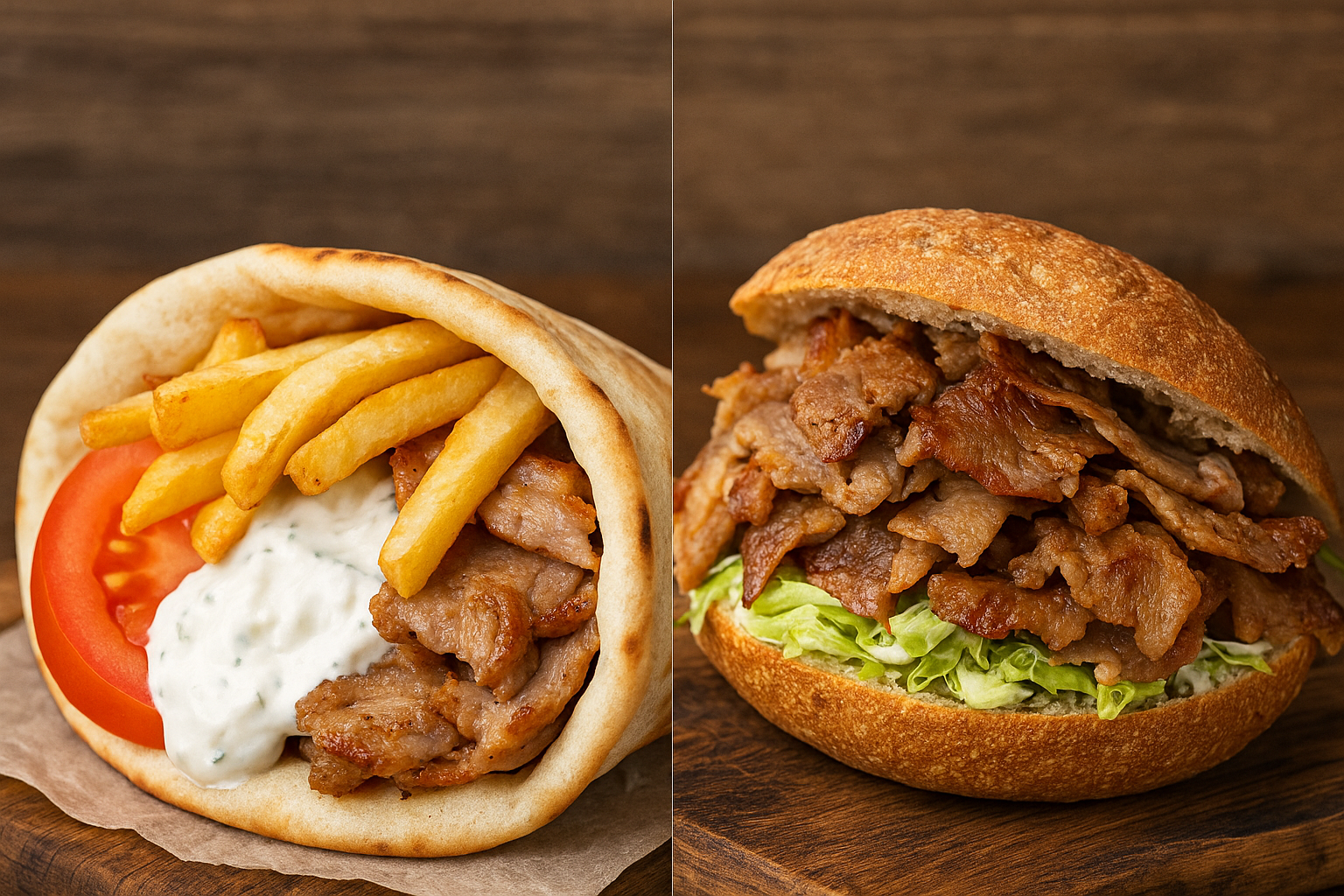
Sauce‐wise, gyros often come with tzatziki (yogurt, cucumber, garlic) and fries stuffed in the pita.
Kebab sandwiches might come with tomato, onions and sometimes spicy sauces, pickles or yogurt sauces — but the spice profile is generally fuller, sometimes hotter.
Serving, Bread & Sides
Gyros in Greece: typically served in pita bread with tomato, onion, tzatziki and often French fries inside the wrap.
The kebab sandwich version (in Europe and Turkey) can be served in pita or flatbread, sometimes on a plate with rice/pilaf, grilled vegetables, pickled items.
Presentation: Gyros are often “grab-and-go” street food, the pita held in hand. Kebab may be fast food or more substantial sit‐down fare depending on region.
Cultural & Regional Notes
The gyros variant spread widely through Greek diaspora and tourist trade; the kebab/döner model has been globalised via Turkish immigrant communities especially in Europe.
In modern usage, the word “kebab” in some countries has become generic for any meat-on-spit sandwich — sometimes blurring the distinctions.
Why It Matters: Choosing Your Sandwich
If you’re after something herbaceous, light, with that cool tzatziki and perhaps fries in the wrap: go gyros.
If you want robust spices, maybe lamb or beef, a rich sauce, and either in pita or on a plate: go kebab.
But don’t stress the names too much — savour the experience, and note that street-food innovation often mixes the defining lines.
—
In the end, gyros and kebab are kindred spirits: rotating meat, urban energy, and the satisfying crunch of charred edges meeting fresh bread. Yet the story of each reminds us of geography and culture: Greece’s sun-kissed herbs and pork, Turkey’s spice-laden lamb and immigrant exportation. The next time you tear through the pita, appreciate that you’re not just eating fast food, but eating food with a story of migration, adaptation and taste. And whether you call it gyros, kebab or something in between — the joy is very real.



Leave a Reply